
China reusable rocket landing achieves successful vertical t
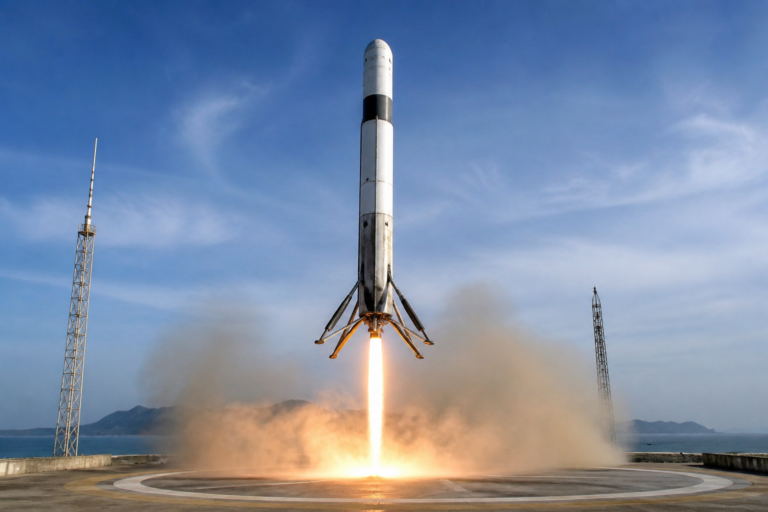
China reusable rocket landing is the focus of this technology-news update.
China Marches Towards Reusable Rockets with Successful First-Stage Landing
The global aerospace industry has increasingly focused on reusable rocket technology as a key factor in reducing launch costs and boosting operational frequency. Within this context, China’s reusable rocket landing efforts have reached a significant milestone with the country’s first successful recovery of a rocket’s first stage. This achievement represents a notable advance in China’s goal to develop the capability to routinely refurbish and relaunch vehicles, marking a new phase in its space program and competitive stance in the international launch market.
Successful First-Stage Landing Marks a Key Achievement
In a recent launch, a Chinese rocket executed a controlled descent and landing of its first stage after delivering a payload to orbit. Developed by LandSpace, a private Chinese aerospace company, the rocket demonstrated precise guidance and intact recovery of the primary booster. This success follows a prior failure in December 2025, making the current accomplishment a crucial step forward for China’s reusable launch ambitions.
The mission employed a medium-lift launch vehicle designed with reusability in mind. After main engine cutoff and stage separation, the first stage reignited its engines for a deceleration burn, followed by a guided descent using onboard navigation systems. The booster ultimately landed vertically on a designated pad, marking China’s first confirmed vertical takeoff and vertical landing (VTVL) of a rocket stage. This milestone underscores the operational progress of China’s reusable launch technology.
Technical Innovations Underpinning the Reusable Rocket
Design Adaptations for Reusability
The rocket’s first stage incorporates structural reinforcements and thermal protection systems absent in expendable models. These enhancements enable the vehicle to withstand the stresses of reentry and landing without critical damage. Additional propellant reserves are allocated to support retro-propulsion burns necessary to slow and stabilize descent.
Landing Mechanism and Guidance Systems
A combination of grid fins provides aerodynamic control during descent, while carefully timed engine burns regulate velocity and attitude. Advanced inertial navigation and real-time telemetry enable the stage to autonomously adjust its trajectory toward the landing pad. Thrust vectoring and landing legs deploy milliseconds before touchdown to ensure a controlled landing.
Innovations Compared to Previous Chinese Launch Vehicles
Earlier Chinese launchers have predominantly been expendable, discarding stages after use. This reusable rocket integrates recovery systems informed by domestic research and international developments. The design reflects lessons learned from past setbacks and incorporates new materials and avionics to support multiple flight cycles.
Impact on China’s Aerospace Industry and Commercial Sector
– Cost Efficiency and Launch Frequency: Reusability has the potential to reduce per-launch costs by eliminating the need to manufacture new stages for each mission, enabling a higher launch cadence and more affordable space access.
– Competitive Positioning: Reliable first-stage recovery enhances China’s competitiveness against global leaders such as SpaceX and Blue Origin, potentially attracting international customers seeking cost-effective launch services.
– Domestic Market Growth: Chinese satellite operators and commercial space companies could benefit from more frequent and cost-efficient access to orbit, facilitating expanded applications in communications, Earth observation, and scientific research.
China Marches Towards Reusable Rockets with Successful First-Stage Landing: Strategic Significance
This first-stage landing milestone embodies China’s strategic objective to develop reusable launch systems within its broader space ambitions. It aligns with a roadmap aiming for fully reusable rockets that may eventually rival or surpass Western equivalents in performance and cost-efficiency. The successful touchdown confirms China’s commitment not only to substantial investment in space but also to advancing the cutting-edge technologies shaping the industry’s future.
Compared to international reusable rocket programs, China’s progress is narrowing the gap. While SpaceX’s Falcon 9 has operationally reused boosters for several years, China’s achievement signals movement beyond experimental stages. Although Blue Origin and others pursue vertical landing techniques, China’s approach applies its own engineering principles adapted to its launch vehicle designs.
Current Limitations and Remaining Challenges
Despite the breakthrough, several technical and operational challenges remain before routine reuse becomes feasible:
– Turnaround Time: The duration and resources required to inspect, refurbish, and certify recovered stages for subsequent flights are not yet fully optimized or publicly disclosed.
– Reliability and Safety: Consistent booster performance across multiple flights demands rigorous validation to prevent mission failures.
– Refurbishment Processes: The endurance of hardware through repeated stress cycles and streamlined refurbishment methods require further development.
These uncertainties indicate that while the first-stage landing is a landmark event, it represents an initial step rather than the completion of China’s reusable rocket development.
Global Context: Reusable Rocket Developments Worldwide
China’s advancement takes place amid a global surge in reusable launch vehicle programs, including:
– SpaceX Falcon 9 and Falcon Heavy: Pioneers in operational booster reuse with numerous successful reflights.
– Blue Origin New Shepard and New Glenn: Focused on suborbital and future orbital reusable vehicles employing vertical landings.
– European and Russian Efforts: Exploring partially reusable concepts, though no fully operational reusable stages have yet been achieved.
China’s progress intensifies competition and could accelerate innovation across the aerospace sector. It also raises considerations about the potential for international collaboration or technology exchange versus strategic rivalry in space launch capabilities.
What to Expect Next: Future Plans and Developments
Following this success, Chinese aerospace entities are expected to conduct additional test flights to refine recovery techniques and assess booster reusability under varying mission profiles. While the timeline for fully operational reusable launches remains uncertain, progress is likely over the coming years.
Future improvements may include enhanced engine restart reliability, automated refurbishment processes, and scaling to heavier-lift vehicles capable of supporting deep space missions. These advances will influence satellite deployment strategies, lower barriers for space startups, and support China’s ambitions for lunar and planetary exploration.
Key Takeaways
– China’s reusable rocket landing efforts have reached a major milestone with a successful first-stage booster recovery, marking the country’s entry into practical reusability.
– Technical innovations include reinforced stage design, advanced guidance, and landing systems enabling vertical touchdown.
– This development strengthens China’s competitiveness and could lead to more affordable and frequent space launches domestically and internationally.
– Challenges remain in turnaround efficiency, safety assurance, and refurbishment before routine reuse is achievable.
– China’s progress contributes to a dynamic global landscape where reusable rocket technology is reshaping aerospace strategy and economics.
Conclusion
The successful first-stage landing represents a pivotal moment in China’s reusable rocket program, highlighting its determination to develop indigenous technologies that reduce launch costs and enhance operational capabilities. While significant hurdles persist, this achievement firmly establishes China on the path toward joining the select group of nations and companies advancing sustainable space access.
Observers should closely monitor subsequent test flights and refurbishment developments to assess how rapidly China can transition from demonstration to routine reuse. As reusable launch vehicles continue to evolve worldwide, China’s progress will remain a crucial factor shaping competition, collaboration, and innovation in the global space industry.
Frequently Asked Questions
What recent milestone has China achieved with its reusable rocket technology?
China successfully landed the first stage of a rocket back on Earth, marking a significant step toward developing reusable rocket technology.
Which organization is responsible for China's reusable rocket development?
China's space agency, the China National Space Administration (CNSA), along with affiliated aerospace companies, is leading the development of reusable rockets.
How does reusable rocket technology benefit China's space program?
Reusable rockets reduce launch costs and turnaround times, enabling more frequent and affordable access to space for various missions.
Are China's reusable rockets currently available for commercial satellite launches?
As of now, China's reusable rocket technology is still in the testing phase and has not yet been widely deployed for commercial satellite launches.
What are the next steps for China following the successful first-stage landing?
China plans to continue testing and refining its reusable rocket technology, aiming to improve reliability and integrate it into regular launch operations.
Source: Original reporting

Leave a Reply