
IBM quantum cryogenic tunnels advance qubit stability in new
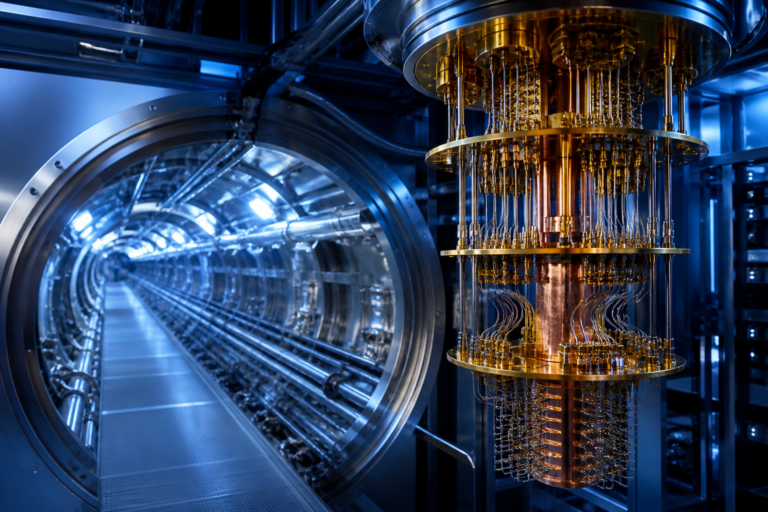
IBM quantum cryogenic tunnels is the focus of this technology-news update.
IBM Says Super-Chill Boxes That Connect Through ‘Cryogenic Tunnels’ Will Get Quantum Computers Scaling
Quantum computing promises transformative advances across many fields, yet building practical, large-scale quantum machines remains a significant engineering challenge. IBM’s recent announcement introduces a novel hardware innovation aimed at overcoming key obstacles to scaling quantum processors. Specifically, IBM says super-chill boxes that connect through “cryogenic tunnels” will enable modular, ultra-cold quantum systems to operate cohesively. This concept addresses critical issues of temperature control, interconnectivity, and noise management that currently limit the expansion of quantum hardware.
IBM’s Breakthrough in Quantum Hardware Design
IBM outlined plans for a new quantum computing architecture based on multiple modular units—called “super-chill boxes”—that maintain quantum processors at temperatures near absolute zero. These modules are linked by “cryogenic tunnels,” specialized conduits designed to preserve the ultra-low temperature environment essential for qubit coherence. This approach departs from the monolithic chip designs commonly used today, where scaling up qubit counts typically requires enlarging a single cooling system, increasing complexity and thermal challenges.
By connecting smaller, independently cooled modules, IBM aims to build larger quantum processors without the thermal and engineering constraints faced by current architectures. The cryogenic tunnels act as temperature-preserving channels, enabling communication between super-chill boxes without raising qubit temperatures or introducing excess noise.
Understanding Super-Chill Boxes and Cryogenic Tunnels
Quantum processors must operate at temperatures just fractions of a degree above absolute zero to maintain qubit coherence and minimize thermal noise. Conventional quantum systems use dilution refrigerators to achieve and sustain these temperatures, but scaling a single refrigerator to support thousands of qubits is prohibitively complex and expensive.
– Super-chill boxes: Modular quantum processing units, each equipped with dedicated cooling systems optimized for extreme cryogenic temperatures. Each box contains a cluster of qubits, control electronics, and shielding components.
– Cryogenic tunnels: Thermally insulated interconnects that maintain the super-chill environment while enabling high-fidelity signal transmission between modules. These tunnels prevent heat influx and preserve delicate quantum states by minimizing thermal disturbances.
This modular design not only simplifies cooling but also offers flexibility in assembling quantum processors tailored to specific computational tasks, potentially accelerating development and improving maintainability.
IBM Says Super-Chill Boxes That Connect Through ‘Cryogenic Tunnels’ Will Get Quantum Computers Scaling
IBM’s assertion that super-chill boxes connected via cryogenic tunnels will enable quantum computers to scale is based on addressing three major technical challenges:
– Thermal management: Maintaining near-absolute-zero temperatures across an expanding quantum processor is essential. Modular super-chill boxes reduce the load on any single refrigeration unit and isolate thermal demands.
– Inter-module connectivity: Quantum processors must transmit signals between qubits without adding noise. Cryogenic tunnels provide low-loss, thermally stable pathways for quantum signals, enabling coherent communication between modules.
– Noise reduction: By partitioning qubits into smaller, controlled environments, the design minimizes cross-talk and decoherence, enhancing overall system fidelity.
This architecture directly tackles the scaling bottlenecks seen in current quantum devices, where increasing qubit counts lead to exponentially more complex cooling and wiring challenges. IBM’s design could accelerate progress toward quantum machines capable of practical, error-corrected computations.
Impact on Quantum Computing Users and Industries
If IBM successfully implements this modular, cryogenically interconnected approach, the implications could be substantial:
– Researchers and developers would gain access to larger, more stable quantum systems, enabling experimentation with complex algorithms previously out of reach.
– Businesses in pharmaceuticals, finance, and materials science could leverage enhanced quantum computing power to solve optimization, simulation, and machine learning problems more efficiently.
– Cloud quantum computing platforms may adopt modular architectures to offer scalable quantum resources with improved uptime and easier maintenance.
Ultimately, this innovation could lower barriers and broaden the quantum computing ecosystem by making hardware more adaptable and scalable.
Positioning IBM’s Innovation Within the Quantum Hardware Landscape
IBM’s approach with super-chill boxes and cryogenic tunnels contrasts with other scaling strategies, including:
– Monolithic quantum chips: Large single-chip quantum processors that face cooling and wiring limitations as qubit counts increase.
– Photonic interconnects: Light-based links connecting quantum modules at room temperature, which face challenges related to signal loss and integration.
– Hybrid systems: Combining different qubit technologies or leveraging classical control systems to manage quantum resources.
While several organizations pursue these avenues, IBM’s focus on cryogenic modularity addresses core physical constraints of superconducting qubits—a leading qubit technology. This emphasis may provide IBM with a strategic advantage in scaling quantum computers in the near to mid-term.
Challenges and Open Questions
Despite its promise, IBM’s quantum cryogenic tunnel concept faces several uncertainties:
– Engineering complexity: Developing reliable, low-loss cryogenic tunnels that maintain ultra-low temperatures over extended distances is a significant technical challenge.
– Integration and control: Coordinating quantum operations across multiple modules requires precise synchronization and error management, which remains unproven at scale.
– Timeline and deployment: IBM has not disclosed specific timelines for prototype development or commercial availability, leaving the pace of adoption unclear.
These factors highlight the experimental nature of the innovation and underscore the need for continued research and validation.
What Happens Next for IBM and the Quantum Computing Field?
In the coming months and years, IBM is expected to undertake extensive prototyping and testing of the super-chill box and cryogenic tunnel design. Key milestones to watch include:
– Demonstrations of stable multi-module quantum operations connected via cryogenic tunnels.
– Performance benchmarks comparing modular systems with monolithic designs.
– Integration of error correction protocols optimized for modular architectures.
Progress in these areas could influence investment trends and encourage other quantum hardware developers to explore modular, cryogenic approaches. Success may also impact quantum software development by providing more reliable and scalable quantum resources.
Key Takeaways: What This Means
– IBM’s new hardware design aims to address fundamental scaling issues through modular quantum processors cooled in super-chill boxes.
– Cryogenic tunnels are critical innovations enabling stable, ultra-cold interconnects between these modules.
– This approach has the potential to accelerate quantum computing scalability by overcoming thermal, noise, and connectivity challenges.
– While promising, the technology remains in development, with practical deployment timelines and engineering details yet to be fully disclosed.
– The broader quantum ecosystem stands to benefit if IBM’s innovation leads to more accessible and powerful quantum computing platforms.
Conclusion: Watching IBM Quantum Cryogenic Tunnels as a Scaling Enabler
IBM’s concept of super-chill boxes connected by cryogenic tunnels presents a compelling new direction in quantum hardware design. By modularizing quantum processors and maintaining ultra-low temperatures through innovative cryogenic interconnects, IBM targets the core physical limitations that currently impede quantum growth. Although challenges remain, this approach could become a key enabler for building practical, large-scale quantum systems capable of delivering meaningful computational advantages.
As competition in quantum computing intensifies, hardware breakthroughs like these will be essential to complement advances in quantum algorithms and error correction. Researchers, industry stakeholders, and developers should monitor IBM’s progress closely to understand how these innovations may shape the quantum landscape in the coming years.
Frequently Asked Questions
What are IBM's 'super-chill boxes' and how do they relate to quantum computing?
IBM's 'super-chill boxes' are advanced cryogenic systems designed to maintain quantum computers at extremely low temperatures necessary for their operation, enabling better scalability by connecting multiple quantum processors through specialized 'cryogenic tunnels.'
How do 'cryogenic tunnels' improve the scalability of quantum computers?
'Cryogenic tunnels' are ultra-cold connections that link separate quantum processors while preserving their quantum states, allowing IBM to effectively scale quantum systems by integrating multiple chips without losing coherence.
Who will benefit from IBM's new cryogenic technology for quantum computing?
Researchers, developers, and enterprises working on quantum computing applications will benefit from enhanced system scalability and performance, potentially accelerating advancements in fields like materials science, cryptography, and complex simulations.
Is IBM's super-chill box technology currently available for commercial use?
As of now, IBM's cryogenic interconnect technology is in the research and development phase and has not been widely commercialized; it is expected to be integrated into future quantum computing systems as the technology matures.
What are the main challenges or limitations of IBM's cryogenic tunnel approach?
Key challenges include maintaining ultra-low temperatures over larger systems, ensuring reliable quantum state preservation across connections, and addressing engineering complexities involved in integrating multiple quantum processors seamlessly.
Source: Original reporting

Leave a Reply