
cyborg cockroaches life saving missions advance disaster res
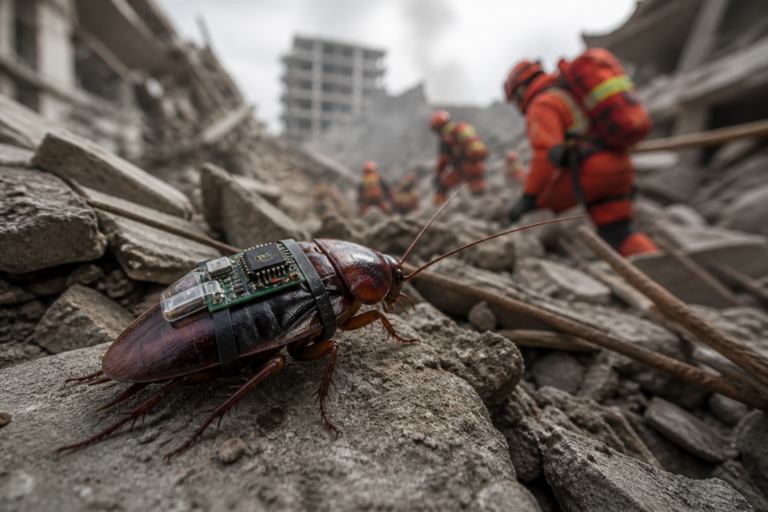
cyborg cockroaches life saving is the focus of this technology-news update.
These Cyborg Cockroaches Could Save Your Life: A New Frontier in Emergency Response
At the intersection of biology and robotics, a novel development promises to transform search-and-rescue operations. Recent reports reveal that researchers have engineered cyborg cockroaches outfitted with embedded electronics, cameras, and remote-controlled delivery systems. This innovation could improve the speed and accuracy of locating and assisting victims in disaster zones, suggesting that cyborg cockroaches’ life-saving capabilities may soon become a vital tool for first responders worldwide.
The Development of Cyborg Cockroaches: Bridging Biology and Technology
Advances in microelectronics and neurobiology have enabled scientists to integrate electronic devices with live cockroaches, creating hybrid systems that capitalize on the insects’ natural agility and resilience. By implanting electrodes into the cockroach’s nervous system, researchers can remotely influence its movements. Miniature cameras provide real-time visual feedback, while micro-injection devices enable the administration of medication to injured individuals.
This breakthrough results from interdisciplinary collaboration among experts in robotics, neurobiology, and emergency response technologies. Although the original report does not specify the involved institutions, it highlights a growing trend in biohybrid research where living organisms serve as platforms for electronic augmentation.
How These Cyborg Cockroaches Could Save Your Life
The practical applications of cyborg cockroaches in disaster scenarios are compelling. Their small size and ability to navigate rubble and confined spaces make them well-suited for locating trapped or injured people in areas inaccessible to conventional robots or human rescuers.
– Enhanced Access: Unlike bulky robotic devices, cockroaches can slip through cracks and debris, reaching terrain that machines cannot.
– Remote Navigation: Operators steer them via implanted electrodes, guiding them toward areas of interest using sensory data.
– Real-Time Environmental Monitoring: Equipped with sensors, these cyborg insects detect hazardous gases, temperature shifts, and structural instabilities.
– On-Site Medical Delivery: The injection apparatus allows remote administration of first aid medication, potentially stabilizing victims before human assistance arrives.
In earthquake-affected buildings or collapsed mines, for example, cyborg cockroaches could be deployed rapidly to scout for survivors, relay critical information, and deliver life-saving substances in environments too dangerous or inaccessible for humans.
Technical Components and Capabilities of the Cyborg Cockroach
This technology relies on a sophisticated integration of biological and electronic systems, involving:
– Electrode Implantation: Electrodes are carefully embedded into the cockroach’s nervous system to control movements such as walking and turning.
– Miniature Cameras: High-resolution micro-cameras transmit visual data wirelessly, enabling remote operators to navigate complex environments.
– Environmental Sensors: Devices detect toxic gases, humidity, and temperature, providing situational awareness critical for rescue decisions.
– Medication Injection Systems: A micro-injection device delivers drugs or fluids precisely to trapped individuals, potentially stabilizing them until rescuers arrive.
– Data Transmission: Wireless communication protocols ensure continuous data flow between the cyborg cockroach and operators for real-time control and monitoring.
Together, these features transform the humble cockroach into a versatile, remotely piloted probe suited for disaster relief missions.
Impact on Emergency Response and Rescue Operations
Integrating cyborg cockroaches into emergency protocols could enhance the effectiveness and safety of search-and-rescue efforts in several ways:
– Increased Speed: Their ability to traverse difficult terrain quickly can reduce the time needed to locate victims.
– Improved Accuracy: Real-time sensory data allows rescuers to make informed decisions about where to focus their efforts.
– Risk Mitigation: Deploying cyborg cockroaches reduces the need to send human rescuers into unstable or hazardous environments prematurely.
– Cost Efficiency: Their small size and relatively low production cost offer a scalable solution for disaster response agencies.
First responders could incorporate cyborg cockroaches into their standard toolkit, potentially reshaping operational procedures to include biohybrid reconnaissance units. This integration might lead to earlier victim detection and improved survival rates in large-scale emergencies.
Comparison with Existing Search-and-Rescue Technologies
While robotic drones, ground-based robots, and trained animals have long supported rescue missions, cyborg cockroaches present unique advantages and challenges:
| Technology | Advantages | Drawbacks |
|——————-|———————————————|——————————————–|
| Robotic Drones | High mobility, aerial perspective, advanced sensors | Limited access to confined spaces, battery life constraints |
| Ground Robots | Robust, strong sensor payloads | Bulky, difficulty navigating rubble |
| Trained Animals | Natural sensing abilities, intuitive navigation | Training complexity, variable reliability |
| Cyborg Cockroaches| Small size, agility, remote control, sensor integration | Control precision challenges, ethical concerns, limited payload capacity |
Compared to existing options, cyborg cockroaches can access tighter spaces and provide direct environmental readings with minimal disturbance. However, achieving precise control over live insects remains technically demanding, and ethical considerations related to animal welfare continue to be debated.
Limitations and Unknowns in Cyborg Cockroach Deployment
Despite their potential, several challenges temper expectations regarding the life-saving capabilities of cyborg cockroaches:
– Technical Precision: Current control methods may lack the finesse required for complex maneuvers in chaotic environments.
– Animal Welfare: Ethical questions arise concerning the implantation of devices in living creatures and the impact on their health and behavior.
– Environmental Constraints: Extreme temperatures, moisture, or debris could interfere with electronics or insect viability.
– Operational Reliability: Long-term field deployment has yet to be demonstrated, leaving durability and maintenance needs uncertain.
These factors underscore the need for further research before widespread adoption in real-world emergencies.
Future Developments and Research Directions
Researchers aim to refine control mechanisms for improved precision and enhance sensor arrays to expand data collection capabilities. Future work may also explore adapting similar biohybrid approaches to other insect species with different mobility traits or environmental tolerances.
Field trials and pilot programs are expected in the coming years to assess the practicality of cyborg cockroaches in diverse disaster scenarios. Advances in microelectronics and bioengineering are likely to accelerate progress, making these systems more robust and user-friendly.
Key Takeaways
– Cyborg cockroaches’ life-saving potential arises from their unique blend of biological agility and electronic control.
– They offer advantages in size, maneuverability, and sensory capabilities over traditional robotic and animal-assisted search methods.
– Significant technical, ethical, and operational challenges remain and must be addressed through continued multidisciplinary research.
– Future enhancements may expand functionality and applications in emergency response and beyond.
Conclusion: Balancing Promise with Practical and Ethical Realities
The emergence of cyborg cockroaches as tools for disaster response exemplifies an innovative convergence of biology and technology with meaningful implications for public safety. While their life-saving potential is supported by notable technological advances, practical deployment requires careful consideration of technical limitations and ethical concerns. Ongoing research and transparent evaluation will be essential to ensuring that these biohybrid systems contribute positively to emergency management without compromising animal welfare or operational reliability.
As the technology matures, stakeholders—including first responders, policymakers, and scientists—should monitor developments closely to determine how best to integrate cyborg cockroaches into comprehensive disaster response strategies, ultimately aiming to enhance rescue outcomes and save lives.
Frequently Asked Questions
What are cyborg cockroaches and how do they work?
Cyborg cockroaches are insects equipped with electronic implants that allow remote control of their movements, typically using lightweight sensors and microcontrollers attached to their bodies.
How could cyborg cockroaches save lives?
They can be used in search and rescue missions to navigate through rubble or confined spaces that are inaccessible to humans or robots, helping locate survivors in disaster zones.
Who is currently developing cyborg cockroach technology?
Several research institutions and universities, including teams in the United States and South Korea, are working on developing and improving cyborg cockroach systems for practical applications.
Are cyborg cockroaches available for commercial or public use?
As of now, cyborg cockroach technology remains primarily in the research and experimental stages and is not widely available commercially or for public use.
What are the limitations and ethical concerns regarding cyborg cockroaches?
Limitations include battery life, control precision, and environmental constraints. Ethical concerns involve animal welfare and privacy implications when deploying such devices in public or sensitive areas.
Source: Original reporting

Leave a Reply