
NASA space telescope mirrors achieve breakthrough precision
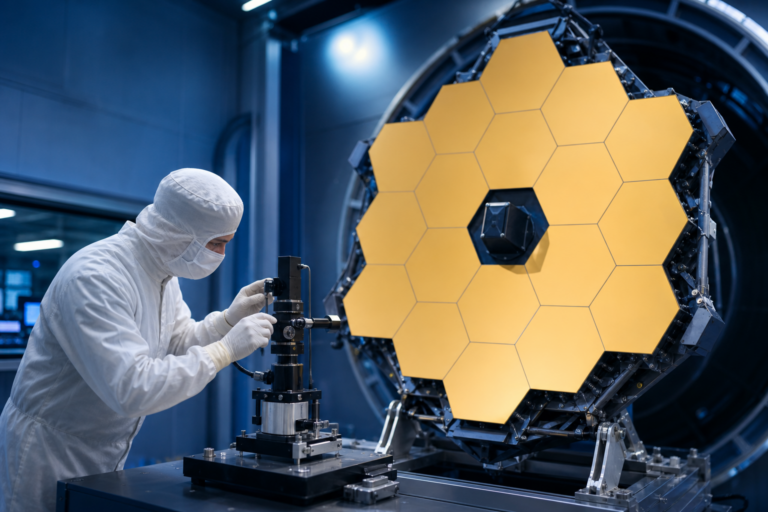
NASA space telescope mirrors is the focus of this technology-news update.
NASA’s upcoming space mission stands to significantly advance our ability to observe distant planetary systems through a breakthrough in telescope technology. Shape-shifting mirrors on NASA’s new space telescope could reveal Jupiter-like exoplanets, marking a major step forward in the direct imaging and study of gas giants beyond our solar system. These innovative mirrors, integrated into the telescope’s active coronagraph system, address longstanding challenges in capturing detailed images of planets orbiting other stars, particularly those similar in size and composition to Jupiter. This development represents a notable leap in adaptive optics technology, promising sharper and clearer views of the cosmos and new insights into planetary formation and atmospheres.
You might also be interested in NASA new space telescope begins groundbreaking deep space ob.Why NASA’s innovative mirror technology matters for exoplanet discovery
Directly observing exoplanets—especially gas giants akin to Jupiter—remains one of the most challenging tasks in astronomy. The intense brightness of a host star often overwhelms the faint reflected light from orbiting planets, rendering them nearly invisible with conventional imaging techniques. This difficulty is amplified when detecting Jupiter-like worlds, which, due to their distance from host stars and relatively low luminosity, demand exceptionally precise instruments.
Traditionally, NASA’s space telescope mirrors have been static or only minimally adaptive, limiting their capability to compensate for distortions or effectively block starlight. The introduction of shape-shifting mirrors, capable of dynamically altering their form, enables the telescope to function as an active coronagraph—effectively suppressing most of the star’s light during observation. This function is crucial for isolating the faint light from gas giant exoplanets, allowing astronomers to study their characteristics with unprecedented clarity.
Development of shape-shifting mirrors for NASA’s new space telescope
The technology behind these shape-shifting mirrors builds on advances in adaptive optics and precision engineering. Unlike traditional mirrors made from rigid substrates, these mirrors incorporate materials and mechanisms that permit minute, controlled deformations of their surface. NASA has refined this technology through extensive testing to ensure that the mirrors can endure the harsh conditions of space while maintaining the precise shape adjustments necessary for optimal imaging.
Recent milestones include successful ground-based demonstrations showing the mirrors’ ability to correct optical aberrations and maintain stability under varying conditions. These achievements have paved the way for integrating the shape-shifting mirrors into the Nancy Grace Roman Space Telescope, NASA’s next-generation observatory scheduled for launch as early as next month. This integration marks the first deployment of an active coronagraph in space, setting a new standard for exoplanet observation.
How shape-shifting mirrors work and their technological advantages
Adaptive optics and mirror deformation
At the core of the shape-shifting mirrors is an adaptive optics system that uses an array of actuators beneath the mirror surface to adjust its shape at a microscopic scale in response to real-time observational data. By precisely deforming the mirror, the telescope can correct optical distortions caused by instrumental imperfections or environmental factors in space, such as thermal fluctuations or mechanical stresses.
Benefits over traditional static mirrors
– Improved image resolution and focus: Dynamic reshaping helps maintain optimal focus throughout observations, enhancing clarity and detail.
– Enhanced starlight suppression: Fine-tuning the mirror surface allows the active coronagraph to more effectively block overwhelming starlight, making faint exoplanets visible.
– Greater observational flexibility: The mirrors can adapt to different targets and viewing conditions, supporting a broader range of scientific investigations.
Shape-shifting mirrors on NASA’s new space telescope could unveil Jupiters like our own
This cutting-edge technology is especially significant for the direct imaging and analysis of Jupiter-like exoplanets. Gas giants in other solar systems provide valuable clues to planetary system formation and evolution, but current telescope capabilities have limited their detection and characterization.
Equipped with shape-shifting mirrors, NASA’s new space telescope will improve the sensitivity and resolution necessary to capture direct images of these distant worlds. Beyond detection, the active coronagraph will enable detailed spectroscopic analysis, revealing atmospheric composition, cloud structures, and even weather patterns on exoplanets. Such data will help astronomers compare these gas giants to Jupiter, enhancing understanding of planetary system diversity.
Expected scientific advancements include:
– Direct imaging: Clearer, higher-contrast images of gas giants near bright stars.
– Spectroscopy: Identification of atmospheric gases such as methane, ammonia, and water vapor.
– Weather and climate studies: Potential insights into atmospheric dynamics, including storms and cloud formations.
Impact on astronomy, space exploration, and scientific research
For astronomers and researchers
The enhanced observational capabilities provided by shape-shifting mirrors expand the tools available for studying planetary systems beyond our own. This advancement opens new avenues for investigating planetary formation, migration, and atmospheric development. Improved comparisons between exoplanetary gas giants and Jupiter will refine models of solar system evolution and inform habitability assessments in other star systems.
For technology developers and space agencies
NASA’s success with shape-shifting mirrors could influence the design of future space telescopes and scientific instruments. The active mirror technology may be adapted for larger telescopes or other observational platforms, both in space and on Earth. Additionally, the precise mirror control and durability techniques developed could find applications in fields such as high-resolution Earth observation and optical communications.
Comparison with existing telescope mirror technologies
Current flagship space telescopes like Hubble and the James Webb Space Telescope (JWST) use highly polished, static mirrors with limited adaptive capabilities. JWST’s segmented mirror design allows some wavefront adjustments but lacks the continuous, fine-scale shape-shifting ability of NASA’s new mirrors. While effective, these systems are constrained in their capacity to suppress starlight or correct dynamic aberrations during observations.
Shape-shifting mirrors represent an evolution beyond these predecessors by combining adaptive optics with an active coronagraph, enabling a level of starlight suppression and image correction previously unattainable in space. This advancement broadens the scope of detectable exoplanets and improves data quality.
Limitations and unknowns surrounding shape-shifting mirror technology
Despite their promise, certain challenges remain. The long-term durability of shape-shifting mirrors in space is not fully proven; factors such as radiation exposure, thermal cycling, and mechanical wear may affect performance over extended missions. Scaling the technology for larger apertures or different telescope architectures may also pose engineering challenges.
Furthermore, the overall impact of these mirrors on mission success will only be measurable after deployment and in-orbit testing. Unforeseen variables could affect image quality or mirror responsiveness once operational.
What happens next: Future steps in testing, deployment, and scientific missions
With launch imminent, NASA plans to conduct in-space demonstrations of the shape-shifting mirror technology during the Roman Space Telescope’s initial mission phases. These tests will evaluate the mirrors’ ability to maintain shape precision and starlight suppression under operational conditions.
Following successful validation, the telescope will undertake scientific missions targeting nearby star systems with known or suspected Jupiter-like exoplanets. The data collected will provide critical insights and inform the design of future observatories equipped with advanced active optics.
Key takeaways
– Shape-shifting mirrors on NASA’s new space telescope could unveil Jupiters like our own by enabling highly precise starlight suppression and image correction.
– These adaptive mirrors represent a significant advancement over traditional static mirrors, improving resolution and observational flexibility.
– The technology promises deeper understanding of gas giant exoplanets’ atmospheres, weather, and formation histories.
– Challenges related to durability and scalability remain and will be evaluated during upcoming space missions.
– Successful deployment could influence future space telescope designs and broaden scientific and technological applications.
Conclusion
NASA’s integration of shape-shifting mirrors into its next-generation space telescope marks a pivotal advance in the pursuit of direct exoplanet imaging, particularly for gas giants resembling Jupiter. By pushing the boundaries of adaptive optics and active coronagraphy, this technology could unveil detailed views of distant worlds previously obscured by their stars’ glare. As the telescope prepares for launch, the scientific community awaits critical validation of these mirrors’ performance in space. The results will not only deepen our understanding of planetary systems but also shape the evolution of space telescope technology for years to come. Observers and researchers alike will be closely monitoring this mission, which heralds a new era in astronomical discovery.
Frequently Asked Questions
What are shape-shifting mirrors on NASA's new space telescope?
Shape-shifting mirrors are adjustable mirror segments that can change their shape precisely to improve the telescope's image quality, enabling clearer and more detailed observations of distant planets.
How do these mirrors help in discovering Jupiter-like exoplanets?
The mirrors enhance the telescope's ability to directly image exoplanets by reducing distortions and improving resolution, which is crucial for detecting and studying gas giants similar to Jupiter.
Which NASA space telescope uses these shape-shifting mirrors?
NASA's James Webb Space Telescope (JWST) employs these advanced shape-shifting mirror segments as part of its primary mirror system.
When will the findings from these mirrors impact exoplanet research?
Observations utilizing the shape-shifting mirrors are ongoing, with significant exoplanet discoveries expected as the telescope continues its mission over the coming years.
Are there any limitations to the shape-shifting mirror technology?
While highly precise, the mirrors require complex calibration and cannot eliminate all imaging challenges, such as interference from stellar brightness or extreme distance of targets.
Source: Original reporting

Leave a Reply