
physicists discover glueballs confirming long-predicted part
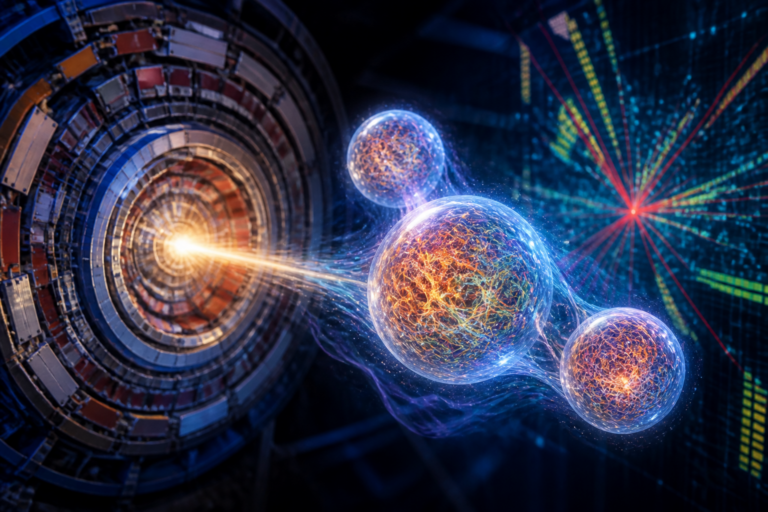
physicists discover glueballs is the focus of this technology-news update.
Have physicists finally discovered glueballs? New evidence points to yes.
The search for glueballs has been one of the most persistent challenges in particle physics for decades. These theoretical particles, composed entirely of gluons—the mediators of the strong nuclear force—have long been predicted by quantum chromodynamics (QCD), the framework that explains the forces binding quarks inside protons and neutrons. Now, recent experimental data provides what researchers describe as the strongest evidence yet supporting the existence of glueballs. This potential discovery not only advances our understanding of fundamental forces but may also influence future technologies rooted in particle physics.
What Are Glueballs? A Primer on Their Theoretical Background
Glueballs are exotic particles hypothesized to form from gluons binding to each other without involving quarks. In contrast to mesons and baryons, which consist of quark-antiquark pairs or three quarks respectively, glueballs are predicted to be purely gluonic bound states. Gluons carry the strong force that holds quarks together within hadrons such as protons and neutrons.
The concept of glueballs arises naturally from QCD, where gluons possess a color charge and can interact among themselves, unlike photons in electromagnetism. This self-interaction allows gluons to form stable or semi-stable composite particles. However, detecting glueballs experimentally has been challenging due to their tendency to mix with ordinary mesons and the complexity of their decay patterns.
For more than 40 years, physicists have sought experimental confirmation of glueballs, but clear, unambiguous evidence has remained elusive. Confirming their existence would validate key aspects of QCD and further enrich the Standard Model, which describes fundamental particles and forces.
Recent Developments in Glueball Research
Recent analyses from a collaborative effort involving major particle physics laboratories have yielded compelling experimental results suggesting the presence of glueball-dominated particles. According to a report published in August 2026 by Ars Technica, this new evidence represents the strongest indication to date that glueballs can exist as distinct entities in nature.
The research draws upon data from high-energy particle collisions, where scientists carefully examined particle decay channels and resonance patterns consistent with theoretical predictions for glueballs. Crucially, these findings were made possible by enhanced detector technologies and advanced data analysis methods, which improved discrimination between glueball candidates and conventional mesons.
This collaboration includes teams from prominent institutions such as CERN alongside other leading accelerator facilities. Their combined efforts have pushed the boundaries of particle detection sensitivity and theoretical modeling, culminating in these promising results.
Key Details of the New Evidence and Experimental Setup
– Experimental Facilities: The experiments utilized upgraded particle accelerators featuring enhanced luminosity and energy resolution, enabling more precise measurements of particle interactions.
– Detection Methods: Advanced detectors captured decay patterns and resonance structures indicative of glueball-like states, including unusual meson spectra and decay rates inconsistent with quark-based particles.
– Data Analysis: Researchers employed refined statistical models and computational techniques to isolate glueball signals from background noise, achieving higher confidence levels than previous studies.
– Statistical Confidence: While still undergoing peer review, preliminary results suggest statistical significance surpassing earlier efforts, supporting the claim that glueball components dominate the observed particles.
– Challenges: A primary difficulty remains disentangling glueball signals from overlapping meson resonances. This issue has been addressed through improved theoretical modeling and experimental precision.
Impact on Physics Research and Technology Development
Confirmation of glueballs would have significant implications for both particle physics and related technological fields. By deepening our understanding of the strong force, physicists can refine QCD models and simulations, leading to more accurate predictions of particle behavior under extreme conditions.
This advancement could influence the design of future particle accelerators and detectors by emphasizing technologies optimized to detect gluonic states and other exotic particles. Improvements in accelerator precision and data processing may accelerate discoveries across fundamental and applied physics.
Beyond fundamental research, insights from glueball physics might intersect with emerging technologies in materials science and quantum computing. A better grasp of gluon interactions could inspire novel approaches to manipulating quantum states or developing materials with properties influenced by strong-force dynamics.
Comparison with Previous Glueball Search Efforts
Earlier experiments seeking glueballs often faced obstacles such as limited detector sensitivity and ambiguous resonance signals that could not conclusively exclude quark-based mesons. Many candidate signals identified in the past were later reinterpreted due to overlapping decay channels and theoretical uncertainties.
The current evidence benefits from technological advancements, including higher luminosity accelerators, improved particle identification algorithms, and more precise theoretical frameworks describing glueball behavior. These developments have collectively enhanced the ability to distinguish glueball states from conventional particles, marking a significant step forward compared to previous attempts.
Limitations and Remaining Unknowns in Glueball Research
Despite the encouraging new data, several questions remain unresolved. The precise properties of glueballs—such as their mass spectrum, lifetimes, and decay modes—are not yet fully established. Although the findings show statistical significance, further verification through independent experiments and additional theoretical work is required.
Competing hypotheses persist within particle physics regarding the interpretation of certain resonance signals, and uncertainties remain about how glueballs mix with ordinary mesons. These complexities underscore the need for continued research to definitively confirm the nature of the observed particles.
What Happens Next? Future Directions in Glueball and Particle Physics Research
– Follow-up Experiments: Researchers plan additional collision runs at upgraded facilities to collect more comprehensive data on glueball candidates.
– Facility Upgrades: Particle accelerators and detectors may undergo further enhancements aimed at increasing sensitivity to gluonic states and refining measurement precision.
– Interdisciplinary Collaboration: Physicists, materials scientists, and quantum computing experts may work together to explore potential applications of glueball-related discoveries.
– Peer Review and Publication: The current findings are expected to undergo rigorous peer review, with the physics community closely monitoring for confirmation or alternative interpretations.
– Long-term Outlook: Definitive confirmation of glueballs could spur new theoretical and experimental avenues, enriching the Standard Model and informing novel technological concepts.
Key Takeaways
– Glueballs are predicted particles composed solely of gluons, the fundamental carriers of the strong nuclear force.
– Recent experimental data offers the strongest evidence yet supporting the existence of glueballs, marking a significant milestone in particle physics.
– Advanced detection methods and improved theoretical models have enabled researchers to better isolate glueball signals from background noise.
– While promising, these findings require further validation through continued experimentation and peer review.
– Potential confirmation of glueballs could impact fundamental physics research and inspire new technological innovations.
Conclusion: The Significance of Potential Glueball Discovery for Science and Technology
The question “Have physicists finally discovered glueballs? New evidence points to yes.” captures a pivotal moment in the transition from theoretical prediction to experimental confirmation in particle physics. Should these findings withstand further scrutiny, they will validate a long-standing prediction of quantum chromodynamics and deepen our understanding of the strong force that governs much of the visible universe.
Moreover, this milestone could drive advancements in research infrastructure and foster cross-disciplinary innovation, potentially influencing future technologies reliant on quantum and material science principles. As the physics community continues to investigate glueball properties and implications, technology enthusiasts and researchers alike will benefit from following these developments closely.
Ultimately, the discovery of glueballs would represent not only a triumph of fundamental science but also a foundational step toward new horizons in technology and our comprehension of the universe’s fundamental forces.
Frequently Asked Questions
What are glueballs in physics?
Glueballs are hypothetical particles composed entirely of gluons, the force carriers that bind quarks together inside protons and neutrons.
What recent evidence suggests physicists have discovered glueballs?
Recent experiments and data analyses in particle accelerators have identified particle signals consistent with glueball properties, providing stronger evidence for their existence.
Why is the discovery of glueballs significant?
Confirming glueballs would validate key predictions of quantum chromodynamics, deepening our understanding of the strong nuclear force and the behavior of gluons.
Who is involved in the research on glueballs?
Physicists working in high-energy particle physics laboratories and collaborations worldwide, including those at CERN and other major accelerator facilities, are conducting glueball research.
What are the next steps following the potential discovery of glueballs?
Researchers will conduct further experiments to confirm glueball characteristics, refine theoretical models, and explore how these particles fit into the standard model of particle physics.
Source: Original reporting

Leave a Reply