
SpaceX Starship test flight achieves key milestone in high-a
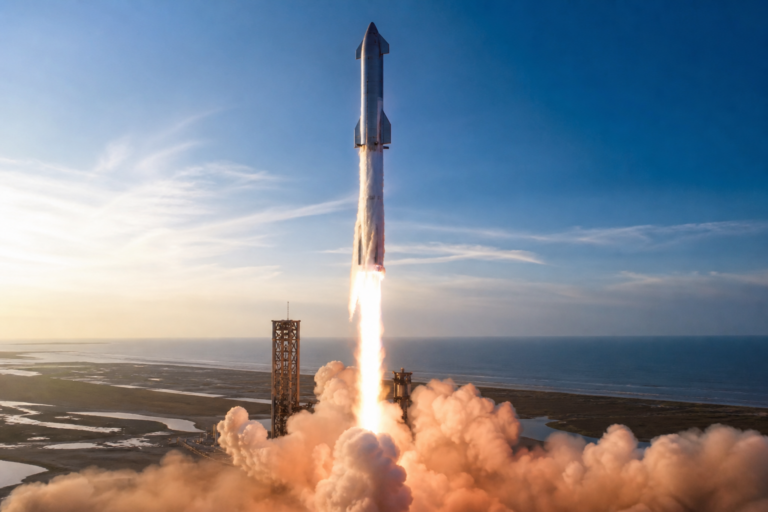
SpaceX Starship test flight is the focus of this technology-news update.
SpaceX Just About Nails Starship Test Flight 13: A Close Call in Advancing Heavy-Lift Spaceflight
SpaceX’s Starship test flight 13 represents a critical step forward in the development of a fully reusable heavy-lift launch system. As the latest in a series of high-profile demonstrations, this mission highlights both notable progress and the ongoing technical challenges involved in pushing rocket technology to new limits. The Starship system—comprising the Super Heavy booster and the Starship upper stage—remains central to SpaceX’s ambitious plans for deep space exploration and commercial spaceflight. Examining the results of this flight provides insight into the program’s trajectory and its broader implications for the aerospace industry.
Overview of Starship Test Flight 13 and Its Significance
Test flight 13 was designed to validate key elements of the fully integrated Starship launch system, with particular focus on engine performance, flight control, and vehicle recovery. Describing the mission as “just about nails” reflects its mixed outcome: many objectives were met successfully, but some anomalies prevented a flawless execution. Such partial successes are typical in aerospace development, where iterative testing and incremental improvements are essential to achieving operational reliability.
Starship test flights serve as vital proving grounds for SpaceX’s vision to deliver a cost-effective, high-capacity vehicle capable of a wide range of missions—from satellite deployment to crewed Mars expeditions. Each flight builds on data collected previously, enabling engineers to refine both hardware and software systems. Within this context, the near success of test flight 13 underscores the program’s momentum and the importance of real-world testing in advancing SpaceX’s long-term goals.
Flight Sequence and Key Outcomes of Test Flight 13
The mission commenced with ignition of the Super Heavy booster’s Raptor engines, propelling the Starship vehicle through ascent. The flight achieved several milestones, including stage separation and ignition of the upper stage. Control of the vehicle during atmospheric reentry was demonstrated, along with attempted recovery maneuvers for both stages.
However, the Super Heavy booster experienced a hard landing, falling short of SpaceX’s objective of a soft, controlled touchdown. Despite this, the upper stage’s reusability systems—including heat shield integrity and avionics performance—functioned as intended, allowing partial hardware recovery. The booster’s rough landing highlighted ongoing challenges related to landing precision and structural resilience under dynamic conditions.
Technical Innovations and Systems Tested in Flight 13
Several advanced technologies integral to Starship’s design were evaluated during this flight, including:
– Raptor engine performance: Multiple Raptor engines on both the Super Heavy booster and the Starship upper stage were tested, with assessments of thrust vectoring and throttle control during ascent and descent phases.
– Avionics and flight software: Updated guidance algorithms and real-time telemetry systems were employed to maintain vehicle stability and trajectory accuracy.
– Thermal protection: Heat shield tiles on the upper stage endured reentry heating, demonstrating resilience and minimal damage consistent with reusability requirements.
The flight also incorporated incremental hardware refinements informed by previous tests, such as reinforced landing legs and improved engine gimbaling mechanisms. Performance metrics like engine efficiency and control responsiveness showed improvement compared to earlier flights, indicating progress toward design maturity.
SpaceX Just About Nails Starship Test Flight 13: Industry Implications and Market Impact
For the aerospace sector, the near-success of Starship test flight 13 reinforces the feasibility of fully reusable heavy-lift launch vehicles. This capability promises to lower launch costs and increase launch frequency—benefiting commercial satellite operators, cargo resupply missions, and future crewed exploration efforts. The demonstrated advancements in reusability technologies may accelerate SpaceX’s timeline for operational Starship missions.
Competitors in the commercial launch market are likely to view the flight’s outcomes as both a challenge and an incentive to innovate. As SpaceX approaches routine Starship operations, other companies may need to expedite their own development efforts to maintain competitiveness. Additionally, government space agencies could leverage Starship’s capabilities for large-scale science and defense missions, potentially influencing procurement strategies.
What SpaceX Just About Nails Starship Test Flight 13 Means for the Program’s Future
The phrase “just about nails” captures the balance between achievement and setback evident in this flight. While many test objectives were achieved, the mission exposed vulnerabilities requiring further attention. Insights gained will guide design adjustments, particularly concerning booster landing systems and structural durability under operational conditions.
SpaceX engineers are expected to conduct detailed analysis of flight data to enhance reliability and reusability. Confidence remains sufficient to proceed with subsequent tests, with a focus on addressing identified weaknesses. This measured approach emphasizes incremental improvements over rapid deployment.
Comparison with Previous Starship Test Flights
Earlier Starship test flights have varied from outright failures to partial successes. Flight 13 demonstrates notable improvement in engine performance and avionics control compared to initial flights, which faced challenges with ignition sequences and vehicle stability. The upper stage’s successful heat shield performance marks progress over earlier tests where thermal protection was a significant concern.
The hard landing of the booster contrasts with some previous missions that achieved softer touchdowns, indicating that landing system reliability remains an active area of development. Overall, test flight 13 fits within a pattern of progressive refinement typical of pioneering aerospace programs—such as NASA’s Apollo and Space Shuttle developments—where iterative testing was crucial to eventual operational success.
Outstanding Challenges and Uncertainties Post-Flight
Despite technological advancements, test flight 13 leaves several challenges unresolved. The hard landing of the Super Heavy booster highlights the difficulty of achieving consistent, low-impact recoveries necessary for rapid reuse. Structural stresses during landing and precise engine throttling in final descent require further optimization.
While the upper stage’s heat shield showed promising performance, its long-term durability through repeated reentries remains to be demonstrated. Questions also remain regarding avionics robustness across varied flight conditions and software reliability in unforeseen scenarios. Some flight data and detailed post-mission analysis have yet to be made public, leaving certain aspects pending confirmation.
Next Steps: Upcoming Test Flights and Program Milestones
SpaceX plans to continue an iterative flight testing schedule aimed at addressing shortcomings identified in test flight 13. Future launches are expected to focus on:
– Improving booster landing accuracy and structural resilience to avoid hard landings.
– Enhancing engine and avionics software tuning to optimize flight control and safety margins.
– Validating complete mission profiles, including orbital insertion and controlled upper stage descent.
Achieving these objectives will be essential before pursuing commercial service certification. Regulatory approvals and coordination with launch infrastructure providers will also be critical as SpaceX transitions from testing to operational deployment. Observers should watch for announcements regarding flight schedules, hardware updates, and test results in the coming months.
Key Takeaways: What SpaceX Just About Nails Starship Test Flight 13 Means for Stakeholders
– The test flight confirms significant progress in engine, avionics, and thermal protection systems, validating key Starship technologies.
– The Super Heavy booster’s hard landing reveals ongoing challenges in achieving reliable, reusable hardware capable of rapid turnaround.
– Incremental improvements bring SpaceX closer to operational readiness, though further testing and refinement remain necessary.
– Industry and commercial customers can expect continued advancements that may reduce launch costs and expand mission capabilities.
– Competitors and regulators will closely monitor outcomes, influencing broader aerospace market dynamics.
Conclusion: Monitoring SpaceX’s Journey Toward Starship Operational Flight
SpaceX just about nails Starship test flight 13, exemplifying the dual nature of cutting-edge aerospace development: significant progress tempered by the need for continued iteration. The mission provides valuable data and experience, highlighting areas requiring engineering focus. Though not flawless, the flight confirms that SpaceX is on a credible path toward establishing Starship as a versatile, reusable launch vehicle.
Going forward, stakeholders should observe how SpaceX addresses booster landing challenges and advances performance improvements in upcoming tests. The company’s ability to convert near-successes into consistent operational capability will determine Starship’s role in transforming access to space. Until then, each test flight remains a pivotal step in this complex but promising endeavor.
Frequently Asked Questions
What happened during SpaceX's Starship test flight 13?
Starship test flight 13 successfully launched and reached high altitude, demonstrating key flight maneuvers before a controlled landing attempt, though it did not achieve a fully flawless landing.
What is the significance of this test flight for SpaceX's Starship program?
The test flight provided valuable data on Starship's flight dynamics and landing capabilities, advancing the development toward fully reusable spacecraft for future missions to the Moon, Mars, and beyond.
Who benefits from the progress made in Starship test flight 13?
SpaceX, its commercial customers, NASA, and the broader aerospace community benefit as the flight moves Starship closer to operational status, potentially reducing launch costs and enabling deeper space exploration.
What are the next steps after the Starship test flight 13?
SpaceX will analyze flight data, address any technical issues observed, and conduct further test flights to refine Starship’s performance and reliability before pursuing orbital missions.
Does the Starship test flight 13 impact the timeline for commercial or crewed missions?
While progress is steady, test flight 13 is part of an iterative development process, so timelines remain flexible; successful tests bring missions closer, but commercial and crewed flights depend on further validations.
Source: Original reporting

Leave a Reply